How Does Luca Bombino Keep Getting Away With It?
A really interesting usage for a really interesting player, and a brief look at off-footed fullbacks

Drop everything you’re doing. We have a left-footed right back.
Luca Bombino has been one of the most exciting young players in MLS in recent years. Playing for an awesome San Diego FC team in their inaugural season, Bombino made 29 starts in 2025 at the ages of 18 and 19, and was number nine on the MLS 22 Under 22 ranking. He’s one of the brightest young American stars in the league, and a real candidate for the USMNT left back spot in the years to come.

Through two games this year, Bombino has done the unthinkable: start twice at right back despite being left-footed. While righties play left back pretty frequently since there are so few left-footed players, lefties in the back line play on the left so exclusively that I couldn’t think of a single example off the top of my head of a left footer starting on the right. A Google search didn’t reveal any such instances, and certainly not two starts in a row.
Bombino isn’t likely to shift to the right permanently. Both Wilson Eisner1 and William Kumado are out with short-term injuries, prompting the switch, but natural right back Oscar Verhoeven and centerback/right back Ian Pilcher were both on the bench against St. Louis, and one of them surely would have gotten the start for almost any other team. Huge props to Mikey Varas for having the courage to try it.

Bombino hasn’t just started at right-back, though. I think he’s actually looked okay at the position, especially in his second match of the year against St. Louis City. Let’s dive into the numbers to see if my eye has been correct, and where the differences have been between his play at left back and on the right.
The Data
In establishing a baseline for Bombino, it’s important to remember that he’s still 19. It’s pretty common for exciting young players to look good to the eye before they do in the data. You can clearly see they have the ability, particularly on the ball and in terms of athleticism, but they don’t figure out how to most effectively channel that ability into actions that actually bring value to their teams until they get some games under their belt. Brooklyn Raines and Kevin Kelsy, for example, are two guys who clearly have ability, and who both made 22 Under 22, but who look like significantly below-average players in the data.
While Bombino isn’t an elite MLS fullback yet, his data is definitely promising. I like to start off with a summary metric, and until I build my own I’m going to stick with American Soccer Analysis’ great Goals Added (G+) figure. Bombino’s goals added vs average per 96 minutes for the 2025 season was 0.03, meaning that compared to an average MLS player, he added 3% of a goal for every 96 minutes (approximately one complete game with added time) he played. This is awesome: he looks like a slightly above-average player. Since it’s a little harder for fullbacks to add value than players at some other positions, Bombino was actually a 73rd percentile G+ player among fullbacks with over 1000 minutes last season. This is awesome for an 18/19 year-old.

This season, on the right, things look worse for Bombino. By G+, he’s been a well below-average fullback, sitting in the 36th percentile of qualified fullbacks with -0.08 goals added/90. In other words, an active negative.

The obvious caveat here is sample size: we’re looking at two games of data, where outliers and oddities can have an enormous effect on results. At this sample size, the eye test is a lot more valuable. I do want to dive slightly deeper into more granular data, though. I’m particularly interested in passing and defense, since by the eye and by player testimony, these aspects seem to vary the most when a player plays on their weak side.
Im going passing first here. I’ve laid out Bombino’s performance across a few key metrics to see where he’s at.


Though, once again, sample size is the elephant in the room, there’s a bit of a change in Bombino’s passing profile. He’s progressing the ball about the same, but his completion has gone down a few ticks, and his expected possession value (EPV) per 100 passes has gone up a good amount.2 This is a simple grid based EPV model, so it is very likely to be skewed by the sample, but the decrease in completion and increase in EPV might indicate a slightly more aggressive pass diet from Bombino this season. Let’s look into that more.
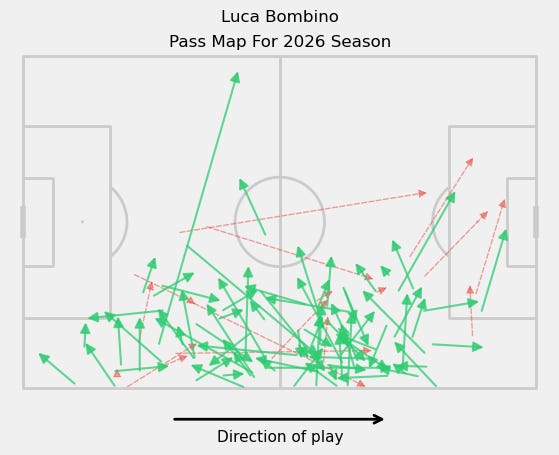
Here’s Bombino’s pass map for both matches this season. There’s three things of note here for me.
First, in the bottom left corner, he’s got a bunch of short backwards and sideways passes. To me, these are the absolutely classic weak-footed fullback “stuck in the corner” passes, where a teammate has to come bail the player out. A strong-footed player has the easy option to clear down the line or punch the ball into midfield. If you’re a Tottenham fan like me, you’ll have seen righty left back Djed Spence do this a trillion times in the last two years.
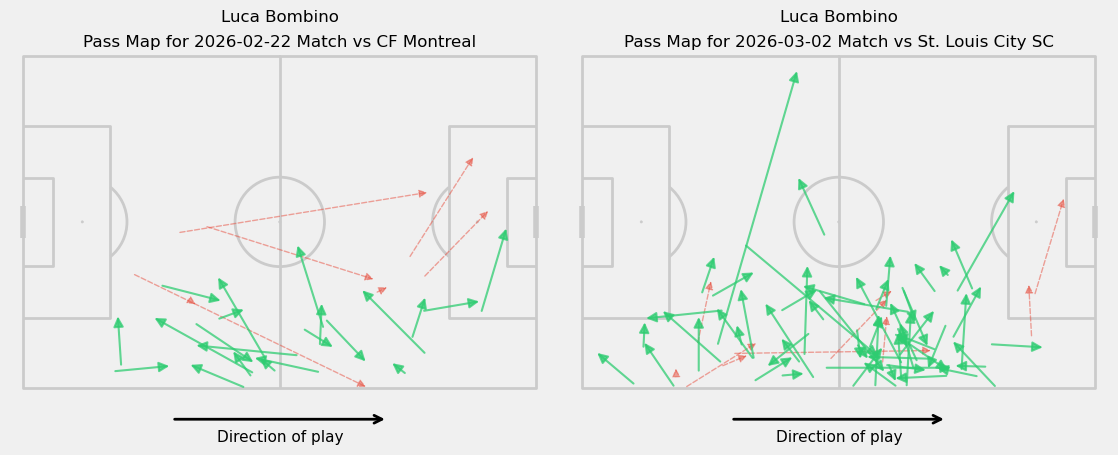
The short passing clumps towards the halfway line tell me a couple of things. First, these are obviously very indicative of the San Diego FC style of play, where players combine over short distances to progress up the field. Nothing groundbreaking there. However, if you look closely and try to decode some of the cluster (pass maps for wide fullbacks are tricky), you’ll notice that almost every pass is backwards or sideways and forward passes are usually short stabs toward the middle rather than the longer line breakers we like to see from progressive players. This makes sense to me. Fullbacks often receive the ball with their back to the sideline, and if you think about defenders closing down Bombino on his right shoulder, his easiest angles on his left are forwards into the middle, or turning and shielding to pass the ball back. He has to turn his entire body into traffic to play a straight ball down the line.
The most encouraging passes for me here are the balls into the box. As might be expected, Bombino isn’t doing a whole lot of getting down the line and crossing from wide on his right foot. Since crossing is the least efficient method of attacking creation, this is good with me. The two passes that might be considered crosses are both from inside the box, and are relatively short balls to very dangerous positions. The one he completed probably represents most of his increased EPV this season. The other super encouraging passes are the half-space cross/through balls that we see from just outside the box towards the far post. This ball has proven to be very efficient in the past, powering championship teams like the 2019-2020 Liverpool squad that set the Premier League points record. This is a really great way for lefties on the right to create, but is usually reserved for wingers.
It is tricky to analyze season-long data with pass maps, but I think this one is pertinent.3
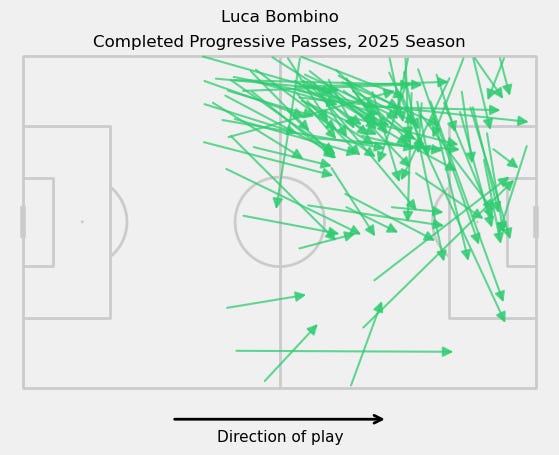
This is obviously not an ideal visual, but we see two things here:
First, those straight passes down the line are there, and some really nice central progressive passes are either from Bombino drifting into the center or some midfield minutes that I don’t know about. This lines up with my preconceptions, which were that players are significantly hampered in progression by playing on the wrong side. Since these are just progressive passes, though, we are missing a lot of classic SDFC recycling that looks similar to his play on the right.
Crossing is the other thing Bombino does on the left that he doesn’t on the right, but for a fullback who started 29 games, this isn’t actually that many crosses. I like this from Bombino. Really cross-reliant guys are often super inefficient.
On defense, I really don’t know if we can tell anything at all.


At a glance, Bombino is down significantly in tackles and interceptions per 96, which might mean that he defends less aggressively on the right than on the left. The sample size here is crushingly small, though, since there’s so many fewer defensive actions in a game than passes. Like most of the discussion in this article, this is a job for a video analyst, which I am not.
Conclusion
The sample size to fully analyze this problem with regards to Bombino using data is unlikely to ever present itself, since when either Eisner or Kumado returns from injury he is likely to shift back to the left. I tried to look into tendencies more broadly by analyzing MLS fullbacks who took a certain amount of touches on each side and looking at their splits, but even that offered a sample too small for real conclusions (there’s really only a couple true fullbacks who have player a lot on both sides recently). I think the pass maps are useful, but at that point you could probably just watch the film. It is clear to me that Bombino’s passing profile changes due to the angles presented to him on his left foot, but that’s about the only real conclusion I could come to. Purely based on the angles I would recommend that teams play their fullbacks on their strong side if at all possible.
Why do this at all, then? This early into the season, nothing is going to have a high enough sample to analyze, so I’d rather look into a cool oddity like Bombino on the right than try to make any real actionable conclusions. This was also an opportunity for me to get used to some new data I got access to, and build some queries and functions that will help me get through the process faster moving forward. I’m happy I did it even if the conclusion is just 🤷.
I overlapped with Wilson for three years in college, and though he was a solid and versatile player, I did not at all expect him to be an MLS starter. Awesome work from him.
Expected possession value attempts to quantify the value a player’s actions (in this case, passes) add to their team’s chance to score goals by measuring where on the field the ball travels.
Opta 2024 progressive pass definition: A completed pass in the attacking two-thirds of the pitch that moves the ball at least 25% closer to the goal.